


Why Rule-Based Upsells Break as You Scale

Table of content
Growth conversations around upselling often focus on tactics, tools, or incremental lifts in AOV. Yet beneath those surface metrics lies a deeper structural question: can the decision architecture behind your upsell strategy scale with the complexity of your business? As brands expand their product catalogs, diversify acquisition channels, and accumulate behavioral data, the challenge shifts from triggering more offers to governing a system that remains aligned with real customer context.
This article examines where rule-based upsells begin to strain under scale, why higher AOV can mask deeper inefficiencies, and how emotional friction quietly accumulates beneath transactional success. More importantly, it reframes the discussion from tool comparison to structural evolution. The real shift is not from rules to AI as a feature upgrade, but from static decision trees to adaptive intelligence infrastructure capable of sustaining long-term, profitable growth.
I. Why Rule-Based Upsells Work at the Beginning
In the early stages of growth, clarity often outweighs sophistication. Rule-based upsells gain traction because they feel structured and controllable. With predefined triggers and mapped offers, teams can clearly see how decisions drive measurable outcomes. That transparency reduces uncertainty and reassures founders that revenue growth is being intentionally engineered.

1. Clarity and Predictability Create Early Confidence
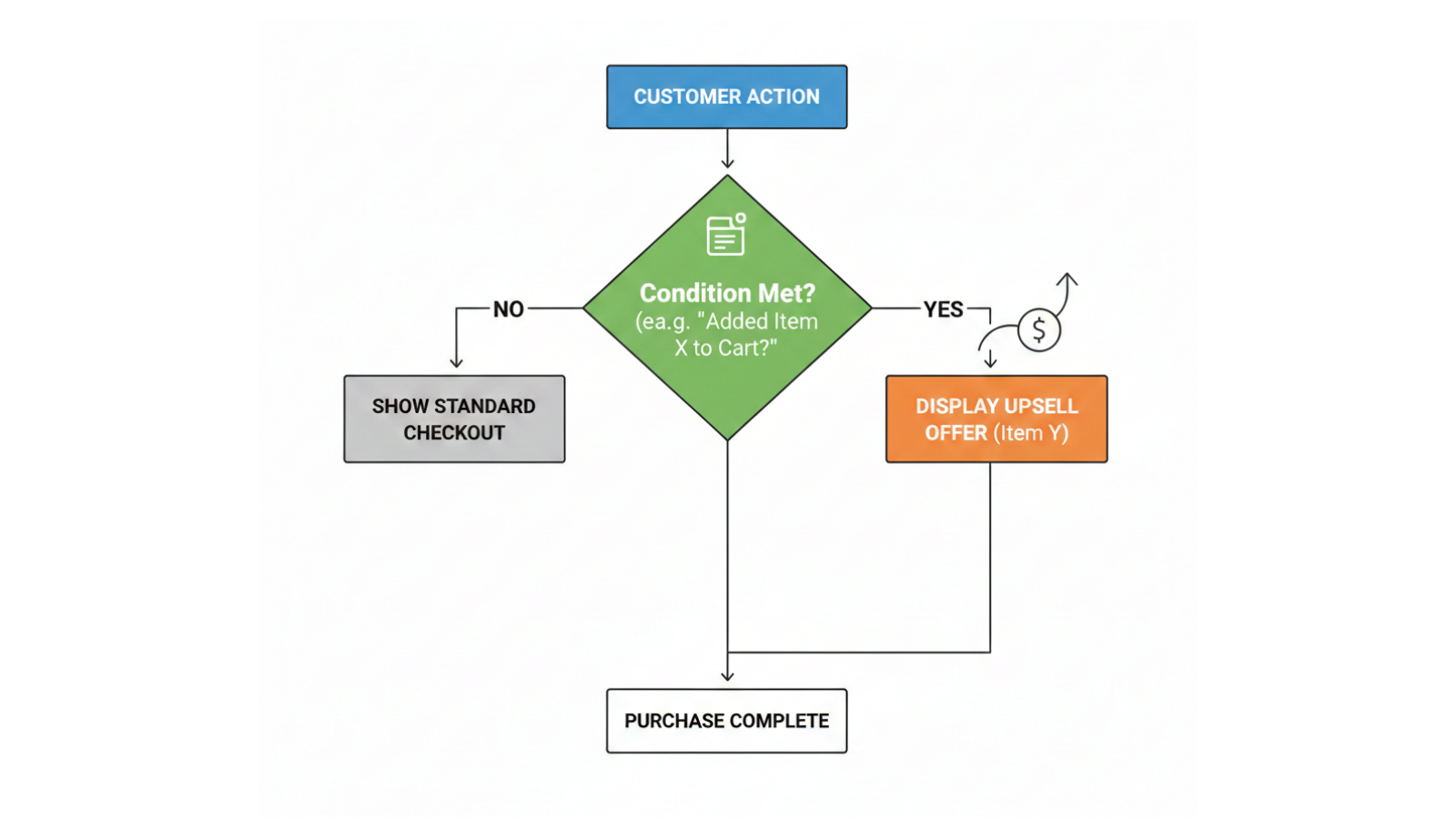
Rule-based logic offers something deceptively powerful: predictability. The decision structure is simple and communicable. If a customer adds Product A, show Bundle B. If the cart exceeds a certain value, trigger Offer C. This clarity makes collaboration easier across marketing, product, and CRO teams because the system’s logic is explicit. For early-stage or mid-scale brands operating with a limited SKU range and fewer traffic channels, this simplicity works effectively. Decision variables remain manageable, and the environment is relatively stable. Under those conditions, rule-based systems appear not only efficient but scalable.
The perception of scalability is reinforced when early metrics validate the approach. According to McKinsey’s report “The value of getting personalization right” (2021), companies that effectively deploy cross-sell and upsell strategies can generate between 10 and 30 percent incremental revenue. However, the report also emphasizes that isolated optimization rarely sustains long-term efficiency without integrated data systems. When brands observe measurable AOV improvements shortly after implementing structured rule-based offers, the system appears proven. Success in the early phase strengthens the assumption that additional rules will proportionally extend performance gains.
2. The Precision Illusion of Conditional Logic
Conditional logic, structured around the familiar “If X, then Y” framework, creates a strong perception of precision. It suggests that customer intent can be predicted and that behavior can be categorized cleanly into predefined scenarios. This model feels analytical and disciplined. It implies that growth can be optimized by layering more refined conditions over time. For teams seeking control, that structure is reassuring.
However, this precision is conditional on stability. The model assumes that customer behavior remains sufficiently consistent for predefined triggers to remain relevant. As long as product catalogs are narrow and acquisition channels are concentrated, this assumption can hold. The simplicity of the system masks its underlying rigidity.
3. The Gradual Drift Toward Misalignment
Rule-based systems rarely collapse dramatically. Their limitations emerge gradually. As SKU counts expand, customer journeys fragment across multiple channels, and promotional layers accumulate, static decision trees struggle to represent real-time context. Research from Baymard Institute consistently shows that ecommerce behavior is highly context-dependent, and friction increases when experiences fail to adapt dynamically to user intent. Static triggers operate on assumptions formed at the time of configuration, while customer intent continuously evolves.
The core issue is not whether rule-based upsells can personalize offers. In many early scenarios, they can. The deeper challenge lies in structural rigidity. What initially feels like operational control slowly becomes an architectural constraint. The system continues to function, but it becomes increasingly misaligned with the complexity of the environment it operates within. The debate, therefore, is not about personalization quality. It is about whether fixed decision structures can sustain growth in a commerce ecosystem that changes faster than static logic can accommodate.
II. When Rule-Based Systems Become Too Complex
Rule-based systems rarely fail because they stop converting. They struggle because the environment becomes more complex than the logic behind them. As brands scale, the challenge shifts from increasing AOV to managing expanding decision variables. What once felt like control gradually turns into structural strain. The real breaking point is not declining performance, but overwhelming complexity.

1. Exponential Variables: When Growth Multiplies Decision Inputs
When we work with scaling ecommerce brands, the first visible shift is rarely in revenue metrics. It appears in system strain. As SKU catalogs expand, acquisition channels diversify, and customer journeys fragment across devices and touchpoints, decision variables multiply far faster than teams expect. A brand that once operated with a focused catalog and limited traffic sources suddenly manages hundreds of SKUs across paid search, paid social, email, affiliate, and marketplace ecosystems.
Each layer introduces additional signals: product margin, inventory pressure, lifecycle stage, acquisition intent, repeat purchase probability, and behavioral segmentation markers. Salesforce reports that 73 percent of customers expect companies to understand their unique needs and expectations. Meeting that expectation requires multidimensional evaluation, not single-condition triggers. In practice, complexity grows exponentially, while rule-based logic scales linearly. That imbalance is where structural tension begins.
2. Rule Stacking and the Rise of Organizational Debt
From our experience, complexity does not feel dangerous at first because every new rule appears reasonable in isolation. A holiday campaign requires exception logic. A subscription incentive introduces category exclusions. A returning-customer offer needs suppression rules for first-time buyers. Over time, brands accumulate layered conditions such as:
- Cart value thresholds tied to promotional bundles
- Category-specific cross-sell restrictions
- Seasonal override conditions
- Inventory-sensitive substitutions
- Segmentation-based suppression logic
Individually, each rule makes sense. Collectively, they form interdependent logic webs where conflicts emerge quietly. One condition overrides another, high-margin offers get suppressed, and testing becomes risky because interaction effects are hard to predict. This buildup creates organizational debt.
In one mid-scale ecommerce brand managing over 600 SKUs across five acquisition channels, rule logic expanded to more than 120 conditional triggers within nine months. Campaign deployment time increased from two days to nearly ten due to cross-validation needs, and experimentation velocity dropped by over 40 percent. Organizational debt forms when only a few people understand the rule architecture, and maintenance begins to outweigh optimization.

3. When Human Oversight Reaches Its Limit
The critical insight is that rule-based systems do not collapse dramatically. Revenue may continue to grow. AOV may remain stable. The breaking point occurs when complexity surpasses human capacity to manage decision trees with confidence. McKinsey’s research on organizational complexity shows that layered processes reduce agility and slow innovation cycles. In ecommerce, this directly impacts experimentation velocity, which is essential for sustainable growth.
AI becomes necessary at this stage not because rules have stopped converting, but because static logic cannot govern exponentially increasing variables. The environment evolves faster than manual rule architecture can adapt. Intelligence becomes a structural requirement, not a performance enhancement.
III. When Higher AOV Doesn’t Mean Healthier Growth
Higher AOV is often seen as a sign of growth maturity. Dashboards improve, order values rise, and upsell strategies seem successful. However, higher AOV does not automatically mean stronger profitability or sustainable unit economics. In many scaling ecommerce businesses, focusing solely on AOV can hide deeper structural inefficiencies.

1. Single-Metric Optimization and Its Hidden Trade-Offs
Rule-based upsell systems are typically designed to optimize one or two primary metrics, most commonly average order value or conversion rate. The logic is straightforward: increase the basket size and total revenue rises. While this works in early phases, it simplifies a far more complex economic equation. Growth at scale depends on balancing multiple variables simultaneously, not maximizing a single outcome.
When optimization is anchored primarily to AOV, several dimensions often receive insufficient attention:
- Contribution margin per order, especially when bundled items carry lower profitability
- Inventory velocity and the strategic movement of slow-moving SKUs
- Sensitivity of high-value customers to aggressive discounting
- Long-term customer lifetime value relative to short-term basket expansion
McKinsey’s research on personalization indicates that advanced data-driven optimization can increase marketing ROI by 10 to 30 percent, but it also emphasizes that sustainable gains require integration across pricing, promotion, and supply chain considerations. Isolated revenue metrics rarely capture this broader efficiency landscape.
2. Revenue Growth Without Efficiency Growth
Revenue can increase while profitability stagnates. AOV may rise because customers are accepting discounted add-ons or lower-margin bundles. However, if contribution margin declines or repeat purchase frequency weakens, the overall economic model deteriorates. According to Salesforce research, 88 percent of customers say the experience a company provides is as important as its products. When upsell logic prioritizes revenue extraction over contextual relevance, it can erode long-term loyalty even if short-term order values improve.
This creates what can be described as a margin illusion. Performance dashboards highlight revenue expansion, yet deeper financial indicators reveal imbalance. Brands may notice subtle warning signs such as:
- Increased promotional dependency to sustain AOV
- Lower repeat purchase rates despite higher first-order value
- Rising customer acquisition costs without proportional LTV growth
- Slower inventory turnover on strategically important SKUs
These signals often appear disconnected, but they share a common root in single-variable optimization logic.

3. Multi-Variable Optimization as a Structural Requirement
Sustainable growth requires balancing revenue, profitability, inventory health, and long-term customer value simultaneously. Static rule-based systems struggle in this environment because they are built around predefined triggers, not dynamic trade-off modeling. Adjusting one rule to improve margin can unintentionally reduce conversion. Optimizing for repeat rate may conflict with short-term revenue goals. Human-managed decision trees become increasingly difficult to calibrate across competing priorities.
This is where AI transitions from enhancement to infrastructure. AI-driven systems can evaluate multiple variables in parallel, dynamically weighing revenue, margin, lifecycle stage, behavioral signals, and inventory conditions within a unified model. Instead of optimizing AOV in isolation, intelligence layers optimize for overall economic efficiency. The objective shifts from maximizing basket size to maximizing sustainable customer value.
The critical shift is conceptual. Growth is no longer defined by how much a single order increases, but by how intelligently revenue aligns with profitability and long-term retention. When complexity reaches that level, multi-variable optimization is no longer optional. It becomes the structural foundation for responsible scaling.
IV. The Hidden Emotional Cost of Static Upsells
Comparisons between rule-based and AI systems usually focus on accuracy or conversion rates. What is often overlooked is the psychological impact of repeated commercial exposure. Upsell interactions shape not only revenue outcomes but also perceived brand intent. When this emotional layer is ignored, subtle friction builds long before it shows up in churn data.
1. Micro-Irritations and the Cost of Predictability
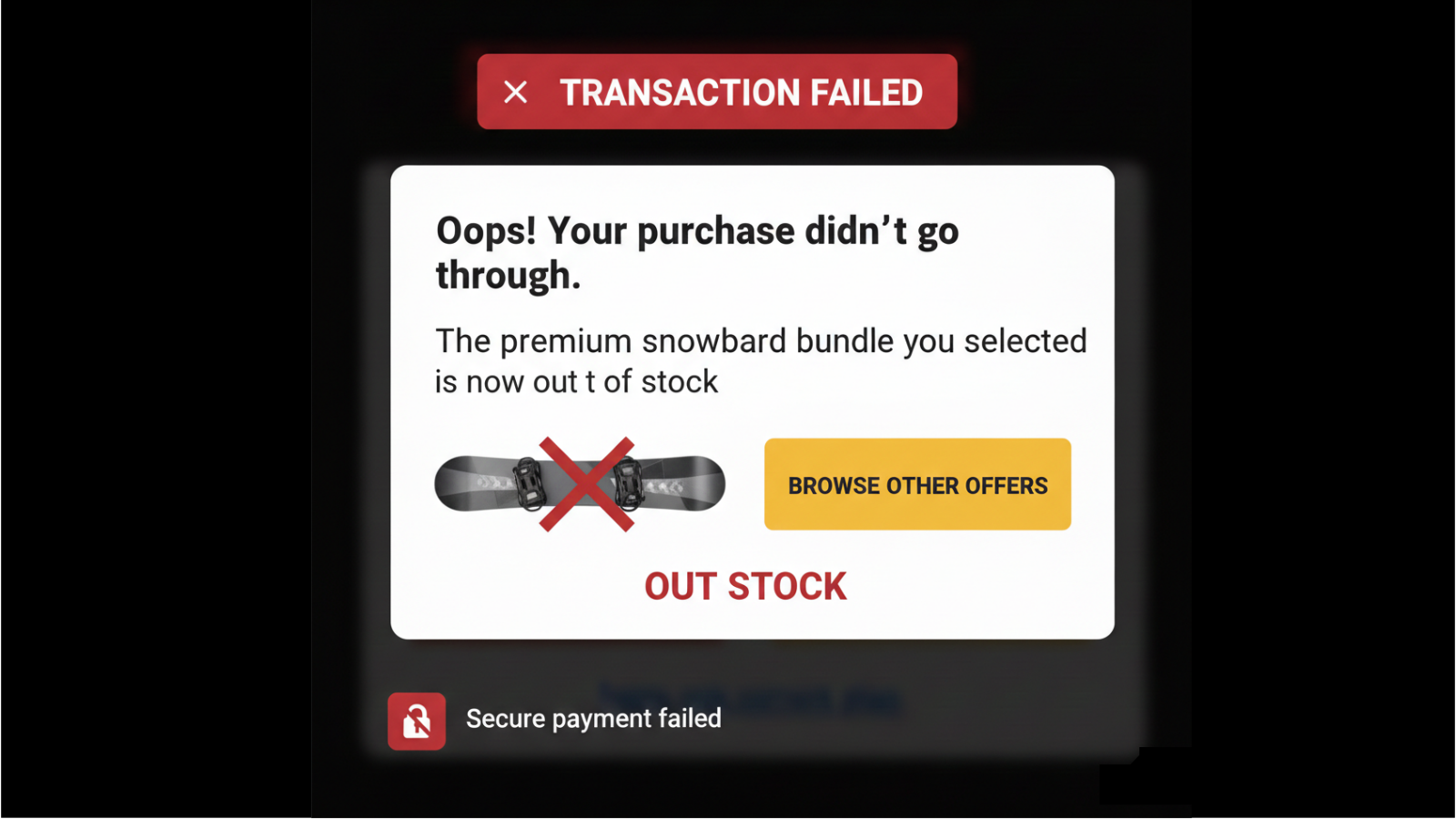
Static upsell logic is inherently repetitive. The same trigger produces the same offer under the same conditions. While this consistency appears efficient internally, customers begin to recognize patterns externally. Predictability in this context does not always signal reliability; it can signal automation without sensitivity. Over time, repeated exposure to identical bundles or discount prompts creates micro-irritations that rarely register as explicit complaints.
These micro-irritations compound through small experiences such as:
- Seeing the same add-on recommendation across multiple sessions
- Receiving identical cross-sell prompts regardless of browsing depth
- Encountering discount-driven urgency even when intent signals are low
Research from Nielsen Norman Group consistently shows that users develop friction when digital experiences feel intrusive or disconnected from context. The friction may not lead to immediate abandonment, but it reduces engagement depth and responsiveness over time. Static triggers do not account for this emotional feedback loop.
2. The Inability to Adjust Pressure in Real Time

Another structural limitation of rule-based systems is their inability to calibrate intensity. Once a condition is met, the offer appears. The system does not evaluate whether the customer is in a high-trust state, whether engagement is declining, or whether repeated exposure is diminishing impact. Pressure remains constant regardless of context.
This rigidity becomes problematic when trust signals weaken. For example, a first-time visitor browsing cautiously should not experience the same promotional intensity as a loyal repeat customer. However, static logic treats both interactions through predefined conditions rather than adaptive assessment. Salesforce data indicates that customer experience now carries equal weight to product quality in purchasing decisions. When upsell interactions feel misaligned with emotional readiness, even subtle misalignment can reduce perceived brand credibility.
3. How Emotional Erosion Manifests Over Time
Emotional erosion rarely shows up as a sudden drop in conversion. It appears gradually through patterns such as:
- Reduced click-through rates on repeated upsell exposures
- Declining responsiveness to promotional messaging
- Offer blindness, where predictable placements are ignored
- Lower engagement with new product launches
- Fatigue toward urgency-driven tactics
Individually, these signals may seem minor. Together, they reflect weakening relational momentum. The system still generates transactions, but emotional resonance declines. The real cost is reduced long-term responsiveness, not immediate churn.
AI-driven systems respond differently. By detecting engagement decay, session shifts, and behavioral signals across touchpoints, adaptive models can adjust intensity dynamically. They reduce pressure when trust is low, recalibrate sequencing based on interaction patterns, and reintroduce offers when engagement recovers. This preserves psychological comfort while maintaining revenue goals. The core distinction is strategic: rule-based systems optimize transactions, while intelligent systems protect relational momentum over time.
V. From Campaign Tool to Growth System
Strategically, the shift is not just from rules to AI, but from campaign thinking to system thinking. Rule-based upsells operate at a tactical campaign level, tied to isolated triggers. As businesses scale, growth relies on interconnected systems, requiring upsell logic to evolve into structural infrastructure.

1. Static Trigger Trees vs Adaptive Signal Aggregation
Rule-based systems rely on static decision trees. When a condition is met, an offer is triggered, and the outcome is measured. While this structure is clear and manageable, it does not learn from behavioral shifts on its own. Any adjustment requires manual updates, and each refinement adds another branch to an already expanding decision tree.
Adaptive models operate differently. Instead of depending solely on predefined triggers, they continuously aggregate behavioral signals such as browsing depth, purchase frequency, product affinity, session duration, margin sensitivity, and engagement trends. These systems weigh multiple signals at once and recalibrate decisions based on performance feedback. McKinsey’s research on advanced analytics shows that companies using real-time, data-driven models outperform peers in profitability and agility because decisions are continuously optimized rather than manually reconfigured. The structural difference becomes increasingly visible at scale: static trees grow by adding rules, while adaptive systems evolve through learning layers. In environments with limited complexity, both models can perform adequately. However, as variables multiply, adaptive architectures tend to sustain alignment more effectively.
2. Internalizing Rules Within a Dynamic Framework
AI-driven systems do not eliminate rules. Instead, they internalize them within a broader probabilistic framework. Conditional logic becomes one input among many rather than the sole decision driver. For example, a traditional rule might specify that customers purchasing Product A should see Bundle B. In a dynamic framework, that association remains relevant but is weighted alongside margin impact, behavioral recency, engagement intensity, and lifecycle stage.
This weighting mechanism allows the system to adjust prioritization dynamically. If engagement signals weaken, the offer intensity can decrease. If margin pressure increases, product combinations can shift accordingly. Instead of adding more conditional layers, the system recalibrates internally. Human teams move from managing rule conflicts to supervising strategic parameters.
3. From Isolated Decisions to Integrated Context Modeling
Campaign-layer logic focuses on isolated decision points, where a single session triggers a single offer. Context beyond that moment is often overlooked. Infrastructure-level intelligence operates differently by integrating signals across browsing history, purchase behavior, engagement cadence, and lifecycle progression. Instead of reacting to one condition, it evaluates the broader behavioral landscape surrounding each customer interaction.
This integration creates contextual coherence. Upsell recommendations reflect not only what is in the cart but how the customer has engaged over time, whether they are new or loyal, price-sensitive or premium-oriented. By modeling context holistically, the system aligns revenue goals with customer state rather than imposing fixed assumptions. Sustainable growth requires this level of embedded intelligence. Adding more campaign rules cannot overcome structural rigidity; only infrastructure-level intelligence can balance revenue, margin, retention, and emotional alignment simultaneously.
VI. When AI Becomes Necessary
At a certain stage of growth, the focus shifts from optimization to architecture. Rule-based systems may still perform on the surface, but underlying stress signals begin to build. The structural moment emerges when decision complexity, operational strain, and economic imbalance converge. At this point, AI adoption is not about trend or curiosity, but necessity.

1. Recognizing the Structural Stress Signals
Brands approaching this threshold often exhibit consistent diagnostic patterns. These signals rarely appear in isolation. Instead, they emerge gradually across operations, finance, and retention metrics.
Common structural indicators include:
- Rising operational complexity, where teams spend increasing time maintaining rule logic rather than designing growth experiments
- Slowed experimentation cycles due to fear of breaking interconnected rule dependencies
- Revenue growth that does not translate into proportional margin improvement
- Stagnating or declining repeat purchase rates despite higher initial order values
Each of these signals reflects a deeper issue. The system continues to generate transactions, yet efficiency, agility, and retention momentum begin to weaken. According to McKinsey’s research on growth resilience, companies that fail to align revenue expansion with operational efficiency often experience diminishing long-term returns even when short-term performance appears stable. In ecommerce, this misalignment frequently stems from static decision frameworks that cannot adapt dynamically to shifting customer behavior.
2. AI as Structural Correction, Not Tactical Upgrade
When these stress signals converge, adopting AI is not a feature enhancement. It becomes a structural correction. Static rule architecture was built for predictable environments. Once scale introduces multidimensional variables across product catalog, channel mix, margin pressure, and lifecycle segmentation, the architecture must evolve accordingly.
Businesses do not migrate to AI because it is innovative or fashionable. They transition because static logic can no longer represent customer reality at scale. Decision trees that once felt precise become insufficient abstractions of dynamic behavior. Human-managed rule stacking reaches a cognitive limit. At that stage, intelligence is required not to improve conversion marginally, but to sustain manageability and alignment.
3. Aligning Revenue With Sustainable Growth
A structured AI upsell system operates as an intelligence layer rather than a promotional tool. Instead of focusing only on increasing basket size, it balances multiple objectives at the same time, including protecting contribution margin, preserving emotional alignment, optimizing lifecycle progression, and strengthening long-term customer value. By dynamically modeling context and continuously weighing behavioral signals, this approach ensures that AOV growth supports profitability and trust rather than quietly eroding them.
At the same time, rule-based systems are not inherently flawed. In low-complexity environments with narrow catalogs and stable acquisition channels, static logic can remain efficient and cost-effective. Structural tension emerges only when environmental variables outpace manual decision architecture. Zotasell is built around this inflection point, functioning not as a standalone pop-up tool but as a coordinated AI layer that aligns revenue expansion with margin health and retention stability. When complexity reaches that threshold, intelligence becomes foundational infrastructure rather than an optional upgrade.
VII. Afterthought
Most brands ask the wrong question. Instead of “When should we switch to AI?”, the real question is whether the current growth model is still built on static assumptions. Rule-based systems reflect predicted behavior, encoding what teams expect customers to do under fixed conditions. That works in stable environments, but as channels fragment and behavior evolves in real time, static logic drifts further from actual customer intent.
AI does not replace rules because it is trendier or superior in isolation. It replaces them because business complexity eventually exceeds human-designed decision trees. Static logic cannot recalibrate continuously, while intelligent systems adapt as signals change. In modern commerce, intelligence is no longer an add-on feature. It becomes the infrastructure that aligns revenue, margin, and long-term customer value.

Join in our newsletter
Need more detail?
Access our Help Center & Resources to learn how Zotasell works, explore use cases, and share with your team.